Zorqemivra
How do I choose the right course for my learning needs?
How do I choose the right course for my learning needs?
Each Zorqemivra course focuses on a particular range of Go programming topics. The collection begins with introductory concepts and progresses toward more detailed programming structures and applied exercises. Review the course descriptions and learning objectives to choose materials that match your current knowledge and interests.
Do I need previous programming experience?
Do I need previous programming experience?
Previous experience is not required for introductory courses. More advanced materials build upon concepts explored in earlier stages, so familiarity with basic programming principles may be helpful. Each course description outlines its intended audience and the topics covered.
What will I find inside the courses?
What will I find inside the courses?
Our courses contain structured written lessons, explanations of programming concepts, illustrative code examples, and practical exercises. Topics and learning activities vary depending on the course. The materials are organized to encourage independent study, careful observation, and gradual development of programming knowledge.
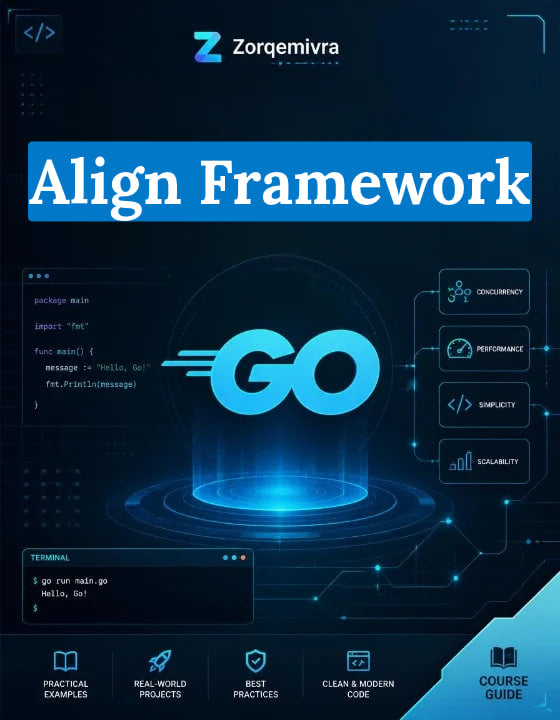
Align Framework
Align Framework
Couldn't load pickup availability
1. Problem Statement
A small program may begin with a few functions but gradually become difficult to navigate. Related operations can spread across files without a clear organizational principle. Changes in one area may affect another in ways that are difficult to anticipate. Repeated manual checks can also leave important cases unexplored. Learners benefit from understanding how structure and testing support continued development.
2. Solution
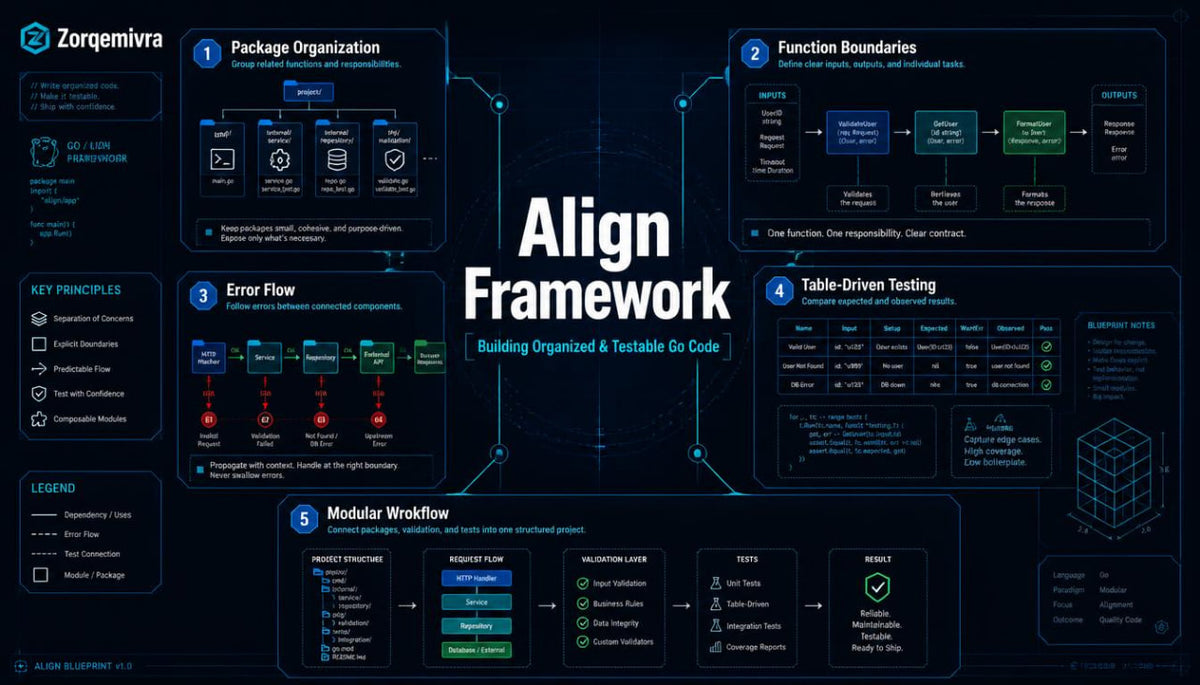
Align Framework introduces code organization through progressively connected examples. Lessons demonstrate how packages group related responsibilities and how functions define clear boundaries. Guided activities compare different arrangements of the same program. Testing exercises show how to verify expected behavior and examine unexpected results. A final workshop combines organization, error handling, and review into one structured study project.
3. What's Inside
Module 1 — From One File to Related Components
Follow a small program as its responsibilities expand. Review how to separate calculation, validation, and presentation logic while keeping each component understandable. Exercises ask learners to explain why particular functions belong together.
Module 2 — Packages and Public Names
Explore package declarations, imports, and Go's capitalization rules for exported identifiers. Examples demonstrate how one package uses a function from another, with attention to naming and avoiding unnecessary dependencies.
Module 3 — Designing Function Boundaries
Examine inputs, outputs, and error values across a sequence of connected functions. Learners compare routines that handle several concerns with alternatives that focus on a single task. Practice includes revising confusing parameter lists.
Module 4 — Tests as Written Expectations
Introduce test functions, table-driven cases, and comparisons between expected and observed results. Activities cover normal values, boundary conditions, and invalid inputs. Short notes demonstrate how a failing case can guide careful investigation.
Module 5 — A Modular Record Workflow
Organize a small record-processing project into packages with distinct roles. Add validation and error responses, then write sample tests for selected operations. Finish by drawing a component map and explaining the movement of data through the program.
4. Who Is This For?
Align Framework is intended for learners who already understand structs, interfaces, functions, and basic error handling. It suits readers ready to examine maintainable program organization and systematic testing. Activities remain focused on compact examples rather than large application development.
5. What You'll Learn
-
Separate related responsibilities into functions and packages.
-
Apply naming conventions to package interfaces.
-
Trace data and errors between components.
-
Write simple table-driven tests.
-
Examine boundary conditions and invalid input.
-
Explain package relationships with a component map.
-
Revise program structure without changing intended behavior.
6. Guarantee
We offer a 30-day money-back guarantee on all paid digital courses and educational materials available through our store.
If you are not satisfied with your purchase, you may request a full refund within 30 calendar days of the original purchase date.
As our courses are delivered digitally, there is no need to return any physical items. Receiving, downloading, or opening the course materials does not affect your eligibility for a refund under this policy.
Refunds will be issued to the original payment method. Processing times may vary depending on your bank or payment provider.
Our 30-day money-back guarantee is provided in addition to your rights under applicable consumer protection laws and does not limit those rights.
Share