Zorqemivra
How do I choose the right course for my learning needs?
How do I choose the right course for my learning needs?
Each Zorqemivra course focuses on a particular range of Go programming topics. The collection begins with introductory concepts and progresses toward more detailed programming structures and applied exercises. Review the course descriptions and learning objectives to choose materials that match your current knowledge and interests.
Do I need previous programming experience?
Do I need previous programming experience?
Previous experience is not required for introductory courses. More advanced materials build upon concepts explored in earlier stages, so familiarity with basic programming principles may be helpful. Each course description outlines its intended audience and the topics covered.
What will I find inside the courses?
What will I find inside the courses?
Our courses contain structured written lessons, explanations of programming concepts, illustrative code examples, and practical exercises. Topics and learning activities vary depending on the course. The materials are organized to encourage independent study, careful observation, and gradual development of programming knowledge.
Cryst Library
Cryst Library
Couldn't load pickup availability
1. Problem Statement
As programs handle more information, storing values in unrelated variables becomes difficult to maintain. Collections may contain the right data while still making individual records inconvenient to locate. A growing number of functions can also obscure which part of a program is responsible for a particular task. Changes to records may produce confusing results when learners have not yet examined how values are passed and updated. These challenges call for a clearer approach to organizing information and the code that uses it.
2. Solution
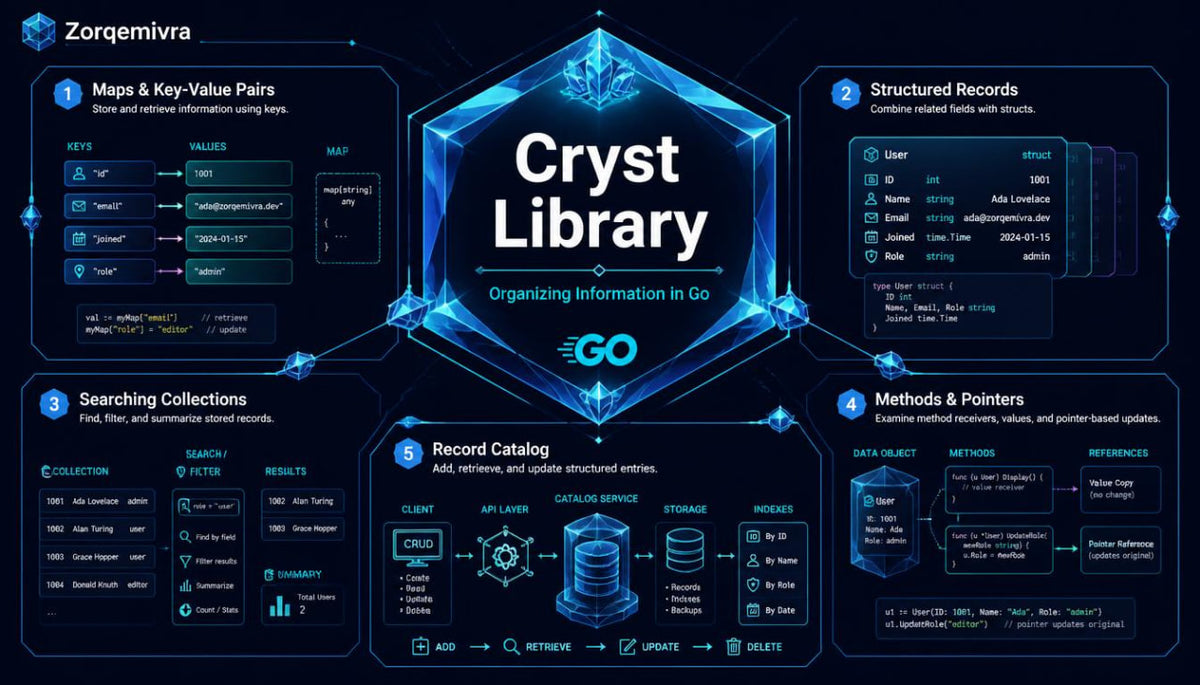
Cryst Library introduces connected techniques for representing, locating, and modifying data in Go. Each lesson starts with a practical question and follows the reasoning behind a suitable structure. Annotated examples show how maps, structs, and functions behave when combined. Exercises invite learners to examine lookup results, revise records, and separate related operations into readable units. A final activity brings the concepts together in a small information catalog.
3. What's Inside
Module 1 — Keys, Values, and Lookups
Study maps that associate identifiers with information. Explore creating entries, retrieving values, checking whether a key exists, deleting entries, and interpreting lookup results when data is missing.
Module 2 — Records With Meaning
Develop structs containing multiple fields and examine how nested records represent connected details. Examples cover field updates, grouping records in slices, and choosing clear names for different kinds of information.
Module 3 — Working Across Collections
Combine maps, slices, and structs to answer questions about stored records. Activities include searching, counting matching entries, and collecting selected values.
Module 4 — Methods and Value Behavior
Introduce methods as functions associated with a type. Compare examples that work with copies of values against examples using pointers, observing how changes may affect the original record.
Module 5 — The Small Catalog Exercise
Develop a compact catalog that stores and retrieves entries using structured data. Follow checkpoints for adding records, finding entries, updating selected fields, and reviewing unexpected results through deliberate testing.
4. Who Is This For?
Cryst Library is designed for learners who have explored Go variables, loops, functions, slices, and introductory structs. It suits readers who want to move from isolated exercises toward programs that handle multiple related records. The course explains each new technique before applying it in connected examples.
5. What You'll Learn
-
Create maps and check whether particular keys are present.
-
Organize related information using structs and nested fields.
-
Combine collections to search, filter, and summarize records.
-
Describe how methods relate to defined data types.
-
Compare value behavior and pointer-based updates.
-
Divide record-handling tasks into clearly named functions.
-
Trace and review changes in a small data-focused program.
6. Guarantee
We offer a 30-day money-back guarantee on all paid digital courses and educational materials available through our store.
If you are not satisfied with your purchase, you may request a full refund within 30 calendar days of the original purchase date.
As our courses are delivered digitally, there is no need to return any physical items. Receiving, downloading, or opening the course materials does not affect your eligibility for a refund under this policy.
Refunds will be issued to the original payment method. Processing times may vary depending on your bank or payment provider.
Our 30-day money-back guarantee is provided in addition to your rights under applicable consumer protection laws and does not limit those rights.
Share