Zorqemivra
How do I choose the right course for my learning needs?
How do I choose the right course for my learning needs?
Each Zorqemivra course focuses on a particular range of Go programming topics. The collection begins with introductory concepts and progresses toward more detailed programming structures and applied exercises. Review the course descriptions and learning objectives to choose materials that match your current knowledge and interests.
Do I need previous programming experience?
Do I need previous programming experience?
Previous experience is not required for introductory courses. More advanced materials build upon concepts explored in earlier stages, so familiarity with basic programming principles may be helpful. Each course description outlines its intended audience and the topics covered.
What will I find inside the courses?
What will I find inside the courses?
Our courses contain structured written lessons, explanations of programming concepts, illustrative code examples, and practical exercises. Topics and learning activities vary depending on the course. The materials are organized to encourage independent study, careful observation, and gradual development of programming knowledge.
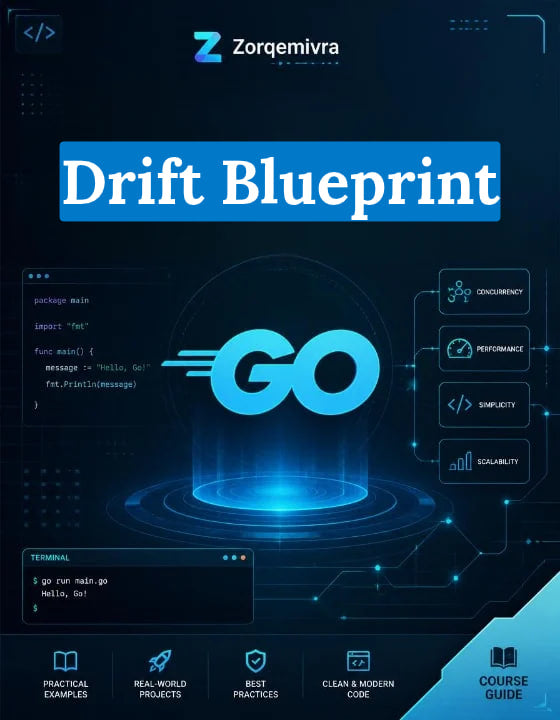
Drift Blueprint
Drift Blueprint
Couldn't load pickup availability
1. Problem Statement
A program that performs several activities can become confusing when operations no longer follow a single sequence. Starting concurrent tasks introduces questions about timing, shared information, and completion. A result may arrive later than expected, while another task may continue after its work is no longer needed. Without careful coordination, these situations can make program behavior difficult to explain. Learners therefore need a structured introduction to concurrency that emphasizes reasoning before complexity.
2. Solution
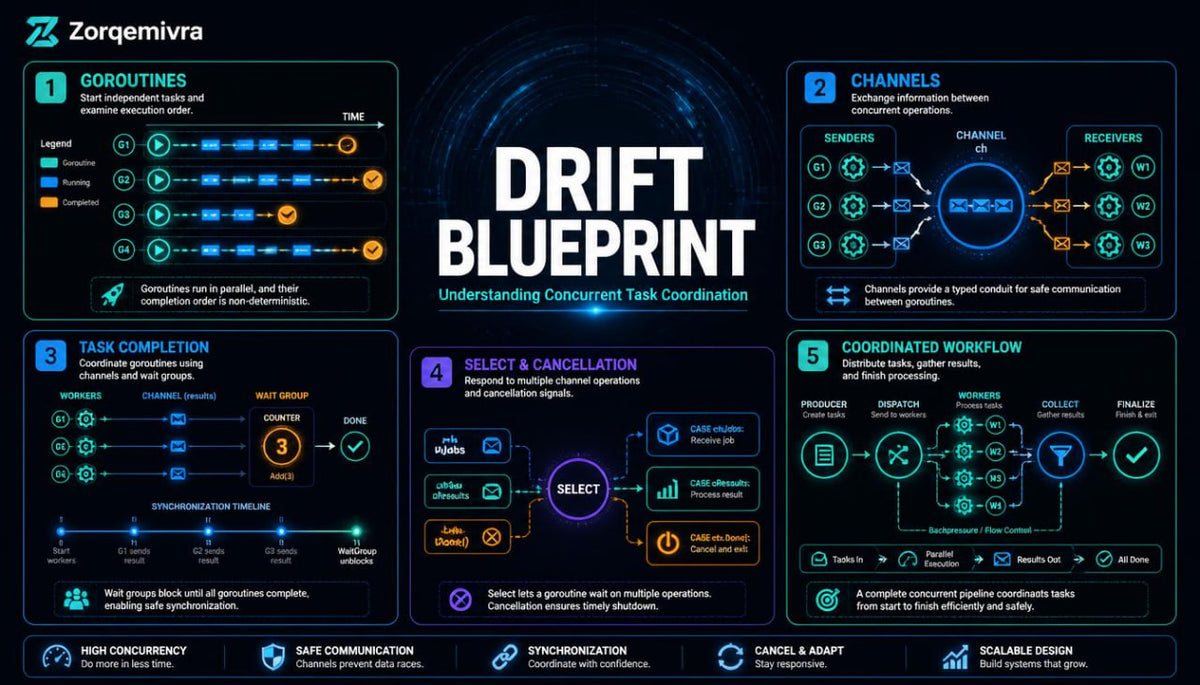
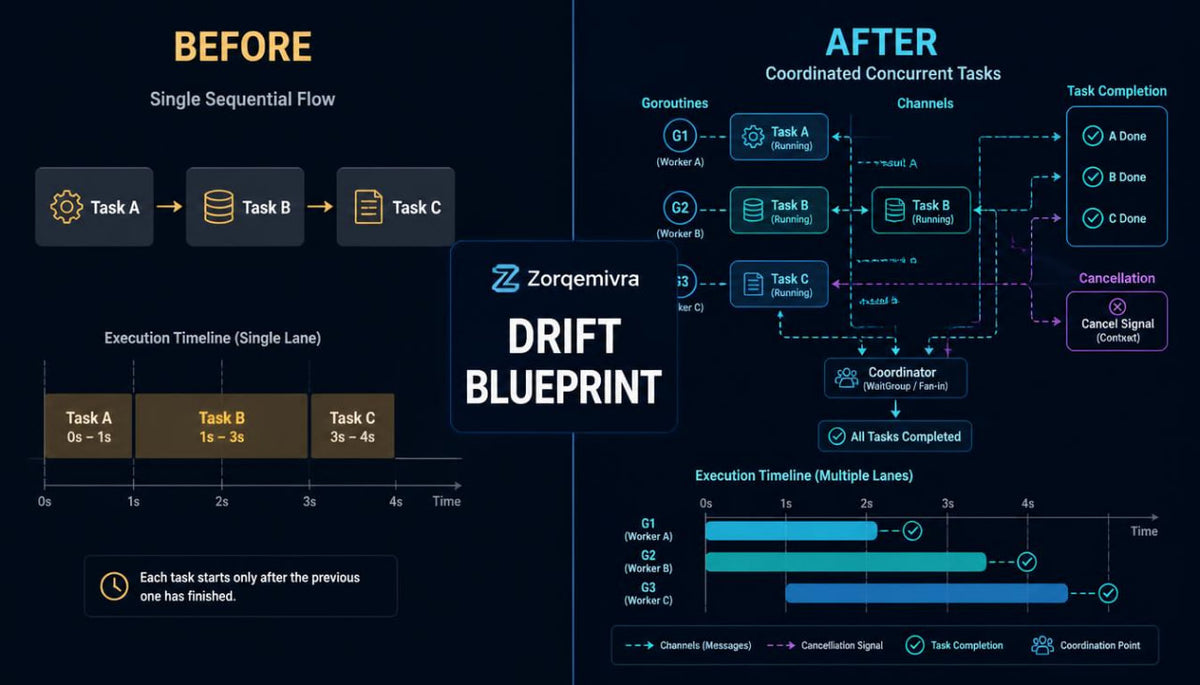
Drift Blueprint examines concurrency through small Go examples with clearly defined responsibilities. Each lesson introduces a coordination question and follows the behavior of its individual tasks. Guided traces demonstrate how channels carry values and how goroutines interact with the surrounding program. Exercises invite learners to revise timing assumptions, handle completion, and consider cancellation. The final activity combines these ideas in a compact workflow with documented observations.
3. What's Inside
Module 1 — Beyond a Single Sequence
Compare sequential execution with tasks started as goroutines. Annotated timelines illustrate why execution order may vary and why beginning a task does not imply that its work has finished.
Module 2 — Messages Between Tasks
Explore channels, sending and receiving values, and the difference between buffered and unbuffered communication. Examples highlight blocking behavior and explain how messages connect independent operations.
Module 3 — Coordinating Completion
Examine channel closing, range over channels, and wait groups. Guided cases illustrate how to recognize unfinished work and coordinate task completion without depending on arbitrary delays.
Module 4 — Handling Multiple Outcomes
Study select statements and basic cancellation with contexts. Examples follow competing channel operations, cancellation signals, and how a task can respond when its result is no longer required.
Module 5 — A Coordinated Processing Exercise
Build a small workflow that distributes sample tasks, gathers results, and completes in an orderly manner. Review questions focus on message flow, shutdown decisions, and observable program behavior.
4. Who Is This For?
Drift Blueprint is intended for learners familiar with functions, packages, error handling, and basic tests. It suits readers who want to explore concurrent task coordination without beginning with a large application. Prior experience with goroutines is not required.
5. What You'll Learn
-
Explain the difference between sequential and concurrent execution.
-
Start goroutines and examine their execution behavior.
-
Send and receive values through channels.
-
Identify blocking operations and completion conditions.
-
Coordinate tasks using channels and wait groups.
-
Describe cancellation and multiple-channel selection.
-
Trace a small concurrent workflow from start to completion.
6. Guarantee
We offer a 30-day money-back guarantee on all paid digital courses and educational materials available through our store.
If you are not satisfied with your purchase, you may request a full refund within 30 calendar days of the original purchase date.
As our courses are delivered digitally, there is no need to return any physical items. Receiving, downloading, or opening the course materials does not affect your eligibility for a refund under this policy.
Refunds will be issued to the original payment method. Processing times may vary depending on your bank or payment provider.
Our 30-day money-back guarantee is provided in addition to your rights under applicable consumer protection laws and does not limit those rights.
Share