Zorqemivra
How do I choose the right course for my learning needs?
How do I choose the right course for my learning needs?
Each Zorqemivra course focuses on a particular range of Go programming topics. The collection begins with introductory concepts and progresses toward more detailed programming structures and applied exercises. Review the course descriptions and learning objectives to choose materials that match your current knowledge and interests.
Do I need previous programming experience?
Do I need previous programming experience?
Previous experience is not required for introductory courses. More advanced materials build upon concepts explored in earlier stages, so familiarity with basic programming principles may be helpful. Each course description outlines its intended audience and the topics covered.
What will I find inside the courses?
What will I find inside the courses?
Our courses contain structured written lessons, explanations of programming concepts, illustrative code examples, and practical exercises. Topics and learning activities vary depending on the course. The materials are organized to encourage independent study, careful observation, and gradual development of programming knowledge.
Slate Concept
Slate Concept
Couldn't load pickup availability
1. Problem Statement
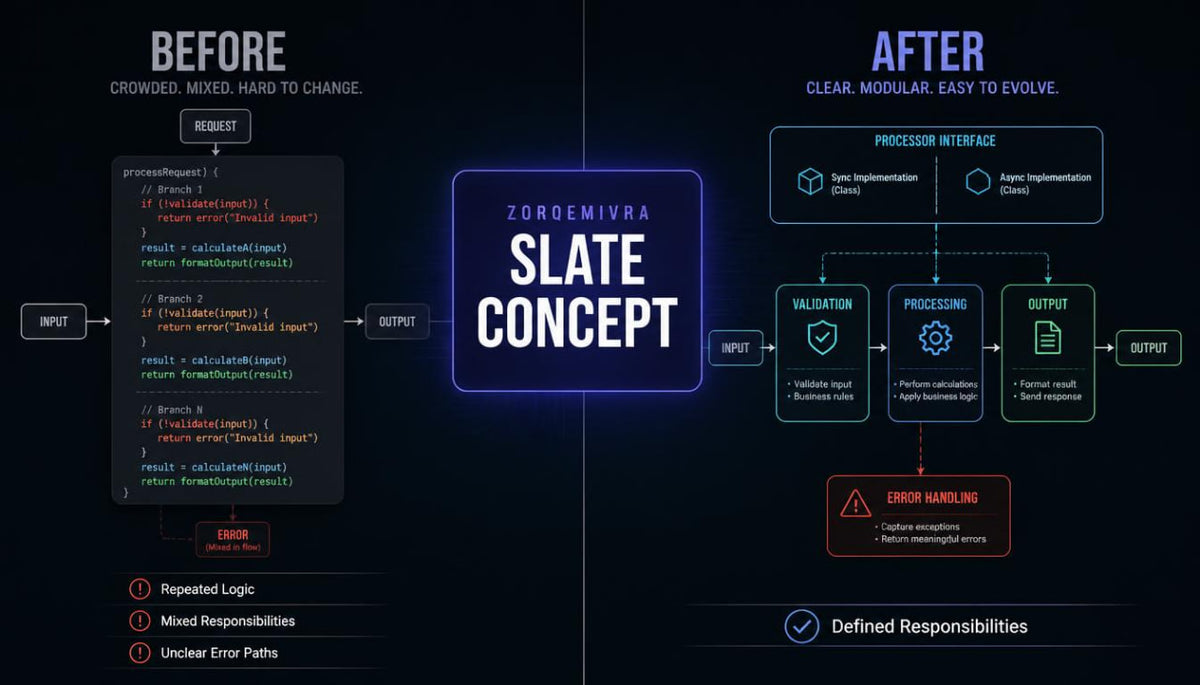
Programs become harder to understand when each operation depends on a specific data type. Similar tasks may require repeated code because the relationships between different types have not been defined. Unexpected input also raises questions about how a program should communicate that an operation did not work as intended. When functions work together, unclear responsibilities complicate debugging and maintenance. Learners need a structured way to reason about these design choices before expanding their projects.
2. Solution
Slate Concept introduces Go interfaces, explicit error handling, and separation of responsibilities through small, connected examples. Each topic begins with a coding situation and examines design decisions. Learners examine how types satisfy interfaces through their methods and how functions report errors to their callers. Exercises explore alternative structures and program behavior. The concluding activity combines these ideas into a compact, organized program with review checkpoints.
3. What's Inside
Module 1 — Behavior Before Implementation
Explore interfaces as descriptions of behavior, not stored fields. Compare different types that implement the same method set, and observe how a function handles values sharing an interface.
Module 2 — Reading the Error Path
Examine error values, returned results, and conditional error checks. Examples show how errors move between functions and how to clarify unexpected conditions.
Module 3 — Clear Responsibilities
Study function boundaries and named operations for defined tasks. Annotated examples contrast crowded functions with arrangements where validation, calculation, and output are handled separately.
Module 4 — Types Working Together
Revisit structs, methods, and pointers in examples involving interfaces. Activities ask learners to predict which values satisfy a particular interface and explain how method receivers affect those relationships.
Module 5 — The Structured Record Exercise
Develop a small record-processing activity with input checks, interchangeable behaviors, and explicit error results. Review its design through trace questions, sample cases, and opportunities to revise the arrangement of functions.
4. Who Is This For?
Slate Concept is intended for learners comfortable with Go variables, collections, structs, functions, and introductory methods. It suits readers who want to understand how several parts of a program can cooperate without becoming tightly coupled. Basic pointer behavior is revisited in the examples.
5. What You'll Learn
-
Describe the purpose of interfaces and method sets.
-
Recognize how different types satisfy a shared interface.
-
Return, inspect, and explain error values.
-
Distinguish validation, processing, and presentation responsibilities.
-
Consider how method receivers influence interface behavior.
-
Organize a short program into focused, readable functions.
-
Trace expected and unexpected outcomes using sample cases.
6. Guarantee
We offer a 30-day money-back guarantee on all paid digital courses and educational materials available through our store.
If you are not satisfied with your purchase, you may request a full refund within 30 calendar days of the original purchase date.
As our courses are delivered digitally, there is no need to return any physical items. Receiving, downloading, or opening the course materials does not affect your eligibility for a refund under this policy.
Refunds will be issued to the original payment method. Processing times may vary depending on your bank or payment provider.
Our 30-day money-back guarantee is provided in addition to your rights under applicable consumer protection laws and does not limit those rights.
Share